Next, I will present the most salient words of the topics of this week
Conduction shape factor
Noun
The heat transfer from one surface (at a temperature T1) to the other surface (at T2) can be expressed as: q=Sk(T1-T2) where k is the thermal conductivity of the solid and S is the conduction shape factor
Example: In particular, the form factor allows calculating the heat transferred between the surface at T1 and the surface at T2.
es: Factor de forma de conducción
Convection resistance
Noun
The resistance model is very useful in determining the heat transfer in a complex steady state heat transfer situation. It is assumes that the heat transfer is primarily one dimensional across the resistance element, so as the problem becomes more multidimensional, the accuracy decreases
Example: For example, assume that the cylinder gas temperature is 1200 K, and the coolant temperature is 300 K. The cylinder thermal conductivity is 80 W/mK, and its thickness is ½" ( 0.012 m). Also assume that the convection coefficient is 200 on the gas side, and 1000 on the coolant side.
es: Resistencia a la convección
Critical radius of insulation
Noun
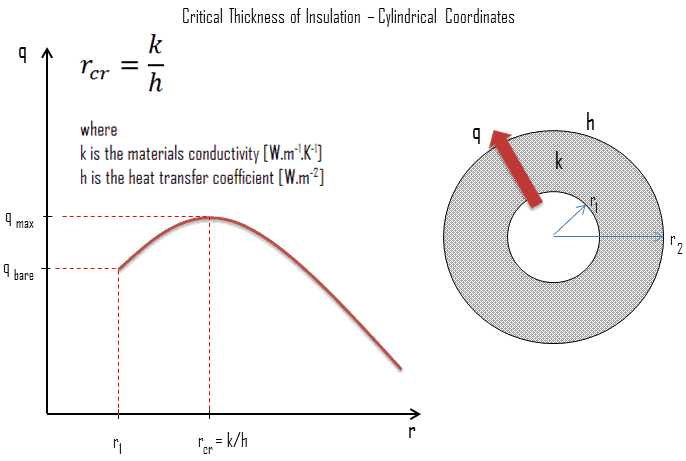
In a cylindrical pipe or a spherical shell, the additional insulation increases the conduction resistance of insulation, but decreases the convection resistance of the surface because of the increase in the outer surface area
Example: Due to these opposite effects, a critical radius of insulation is defined as the outer radius that provides maximum rate of heat transfer
es: Radio crítico de aislamiento
Cylinder conduction resistance
Noun
Steady state heat transfer through pipes is in the normal direction to the wall surface (no significant heat transfer occurs in other directions). Therefore, the heat transfer can be modeled as steady‐state and one‐dimensional, and the temperature of the pipe will depend only on the radial direction, T = T (r).
Example: A través de los puntos de contacto del sólido, el calor se transmite por conducción mientras que a través del fluido de la interfase el calor se transmite por convección y radiación.
es: Resistencia de conducción del cilindro
Efficiency
Noun
the ratio of the useful work performed by a machine or in a process to the total energy expended or heat taken in.
Example: the boiler has an efficiency of 45 percent
es: Eficiencia
Fin effectiveness
Noun
The fin temperature effectiveness or fin efficiency is defined as the ratio of the actual heat transfer rate through the fin base divided by the maximum possible heat transfer rate through the fin base
Example: The concept of fin efficiency accounts for the reduction in temperature potential between the fin and the ambient fluid due to conduction along the fin and convection from or to the fin surface, depending on fin cooling or heating situation.
es: Eficacia de la aleta
Fin efficiency
Noun
Fin efficiency is defined as the ratio of actual heat flow of the fin to that which would be obtained with a fin of constant temperature uniformly equal to the base surface temperature, that is, one with infinite thermal conductivity.
Example: This definition is very useful. It is easy to calculate the denominator in the definition. Then, if the efficiency of a fin is known, the heat transferred by the fin can readily be determined
es: Eficiencia de las aletas
Interface resistance
Noun
Decreased heat flow caused by imperfect contact between two materials at an interface.
Example: Solving a heat transfer problem in such a medium requires solving the heat transfer problem in each layer and an interface condition must be specified at each interface.
es: Resistencia de interfaz
Plane wall conduction resistance
Noun
Conduction is the transfer of energy from the more energetic particles of a substance to the adjacent less energetic ones as result of interactions between the particles.
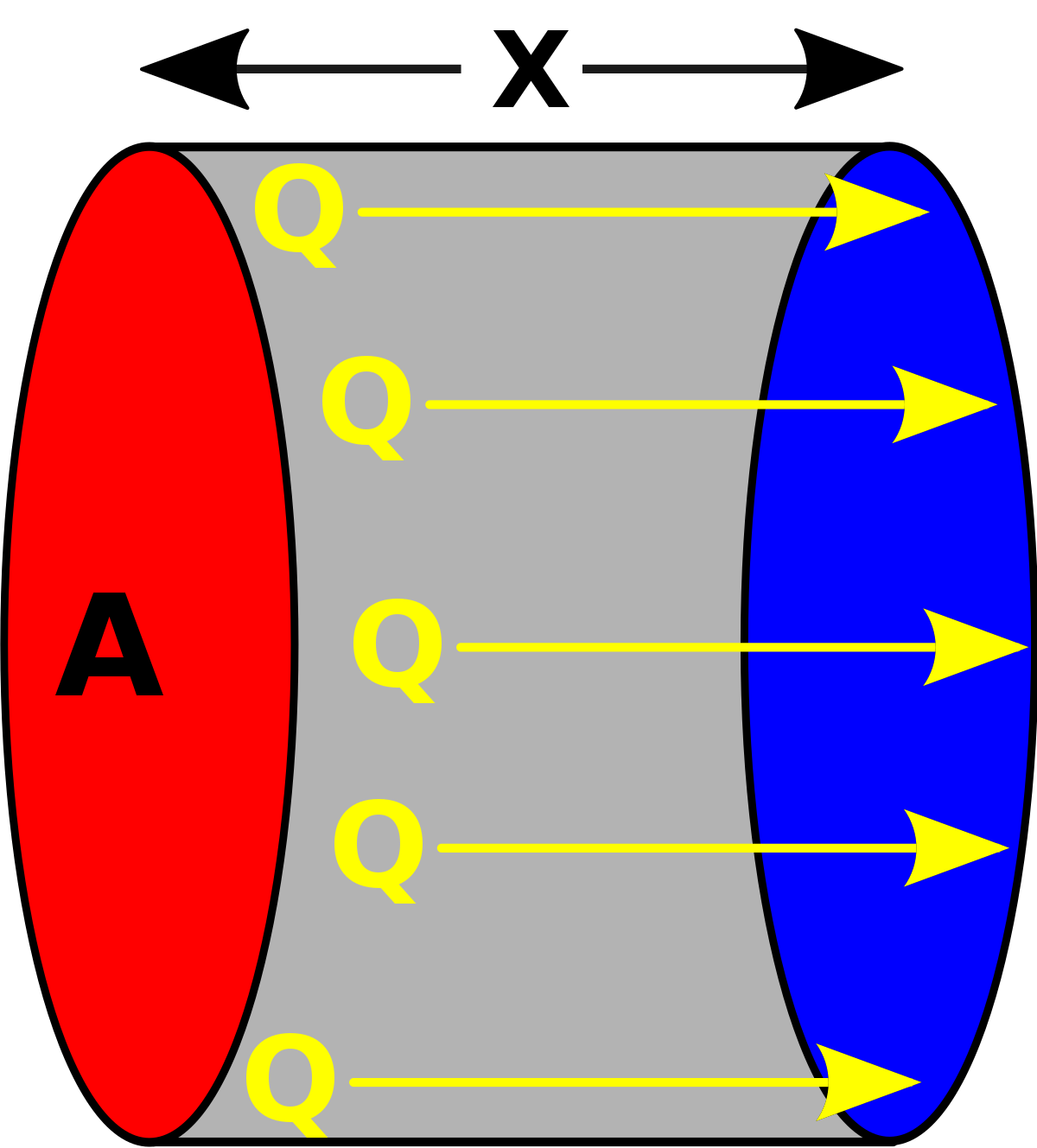
Consider steady conduction through a large plane wall of thickness Δx = L and surface area A. The temperature difference across the wall is ΔT = T2 – T1.
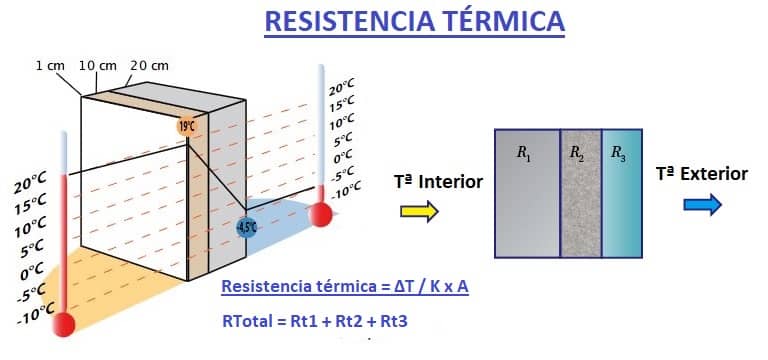
Example: The speed of heat transfer can be viewed as a flow, and the combination of thermal conductivity, material thickness, and area as a resistance to such flow. temperature is the potential or driving function of heat flow.
es: Resistencia a la conducción de la pared plana
Radiation resistance
Noun
Radiation resistance is the part of an antenna's power point electrical resistance that is caused by radiation from electromagnetic waves from the antenna.
Example: In radio transmission, a radio transmitter is connected to an antenna.
es: Resistencia a la radiación
Sphere conduction resistance
noun
The inner and outer surfaces are maintained at constant but different temperatures t1 and t2 respectively. Geometrical symmetry indicates that the heat flow is limited to radial direction only. Further if temperature t1 at the inner surface is greater than temperature t2 at the outer surface, the heat flows radially outwards.
Example: Consider heat conduction through a hollow sphere of inner radius r1, outer radius r2 and made of a material of constant thermal conductivity.
es: Resistencia a la conducción de la esfera
Surfaces
Noun
the outside part or uppermost layer of something (often used when describing its texture, form, or extent).
Example: a small path surfaced with terra-cotta tiles
es: Superficies
Thermal contact conductance
Noun
thermal contact conductance is the study of heat conduction between solid bodies in thermal contact.
Example: The thermal contact conductance coefficient is a property that indicates the thermal conductivity, or ability to conduct heat, between two bodies in contact.
es: Conductancia de contacto térmico
Thermal contact resistance
Noun
When two solid bodies come in contact, such as A and B in Figure 1, heat flows from the hotter body to the colder body. From experience, the temperature profile along the two bodies varies, approximately, as shown in the figure. A temperature drop is observed at the interface between the two surfaces in contact.
Example: This phenomenon is said to be a result of a thermal contact resistance existing between the contacting surfaces. Thermal contact resistance is defined as the ratio between this temperature drop and the average heat flow across the interface.
es: Resistencia al contacto térmico
Total thermal resistance
Noun
Thermal resistance is a heat property and a measurement of a temperature difference by which an object or material resists a heat flow. Thermal resistance is the reciprocal of thermal conductance.
Example: copper has a lower electrical resistance than wood and short and thick conductors have less resistance than long and thin